From Exhibit to Institution: A Journey of the International Wolf Center and Its Role in Wolf Education History
In 1985, the relationship between wolves and other living creatures took center stage at the “Wolves and Humans” exhibit at the Science Museum of Minnesota. Developed by biologist Dr. L. David Mech, this groundbreaking display received numerous awards and embarked on a remarkable journey across 19 cities throughout the U.S. and Canada, enlightening over 2.5 million visitors about wolf behavior and the rich folklore surrounding these enigmatic creatures.
Inspired by the exhibit’s success, a group of dedicated wolf enthusiasts, including Dr. Mech, began envisioning a permanent home for this vital project. This vision gave rise to the Committee for an International Wolf Center, which found its perfect location in Ely, Minnesota—nestled in the heart of the largest gray wolf population in the contiguous United States.
The history of research on gray wolves in Ely has significantly enhanced our global understanding of this remarkable species, with pioneering studies by legends Sigurd Olson and Milt Stenlund laying a strong foundation, while Dr. Mech, the foremost authority in the field, studied wolves from this area for nearly six decades.
In 1989, a temporary facility was established in Ely, marking the beginning of an exciting new chapter in the Center’s history. Then, in June 1993, the International Wolf Center proudly opened its state-of-the-art facility, a $3 million, 17,000-square-foot space adorned with the award-winning “Wolves and Humans” exhibit. This initiative was funded through a generous $1.2 million contribution from the State of Minnesota, a $125,000 grant from the Iron Range Resources and Rehabilitation Board and numerous individual and foundation gifts. A significant expansion in 1998 further enhanced the Center, introducing a wolf-viewing theater and additional educational resources, adding to the rich history of the exhibits presented. On June 28, 2019, the “Wolves and Humans” exhibit was replaced with a new immersive “Discover Wolves” exhibit featuring wolf howls, northern lights and a simulated airplane ride with a wolf researcher. This new exhibit was funded in part by the Legislative-Citizen Commission on Minnesota Resources, along with significant private funding.
Visitors can view the ambassador wolves through expansive observation windows overlooking a 1.25-acre enclosure. The Center’s first exhibit pack included four wolves born in April 1993. Wolf pups are introduced to the Exhibit Pack approximately every four years.
The Center’s engaging educational programs include half-day or multi-day adventure programs that offer visitors invigorating outdoor experiences, including thrilling howling trips. These programs attract participants from all 50 states and 28 countries.
Moreover, the Center extends its outreach beyond Ely through an immersive website, an informative quarterly magazine, WolfLink virtual learning programs and captivating webcams, all dedicated to fostering awareness about wolves and wolf populations around the world, thus weaving the history of wolf conservation into the fabric of public knowledge..
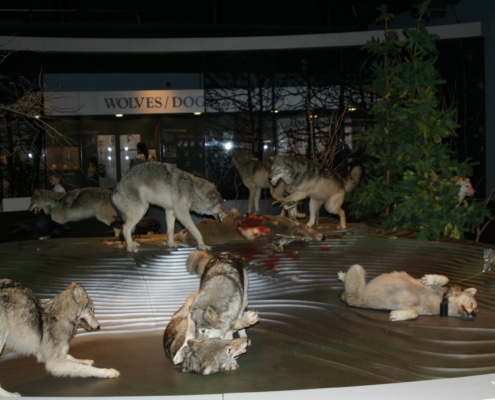
The “Wolves and Humans” embarked on a remarkable journey across 19 cities throughout the U.S. and Canada and became a permanent exhibit at the International Wolf Center in June 1993.
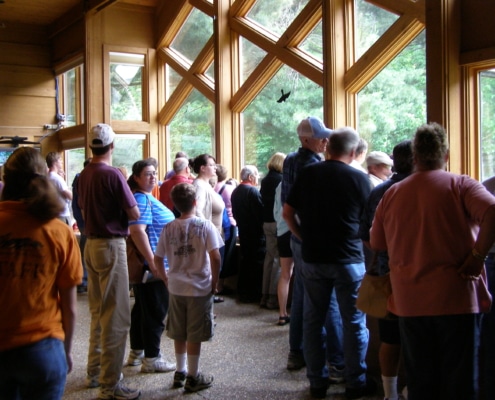
Visitors can view the ambassador wolves through expansive observation windows overlooking a 1.25-acre enclosure.
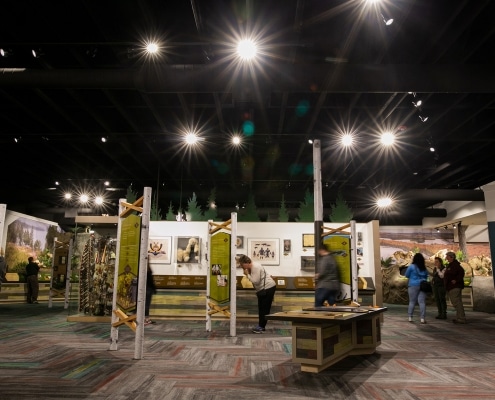
On June 28, 2019, the new immersive “Discover Wolves” exhibit opened at the Center featuring wolf howls, northern lights and a simulated airplane ride with a wolf researcher.