The wolf is a generalist carnivore, an animal suited for catching, killing and eating other animals. Wolves prey primarily on large, hoofed mammals called ungulates. For example: In Michigan, Wisconsin and Minnesota, the white-tailed deer is the wolf’s primary prey, with moose, beavers, snowshoe hares and other small mammals also being taken. Elsewhere, wolves’ primary prey may be caribou, musk-oxen, bison, Dall sheep, elk, mountain goats or other ungulates.
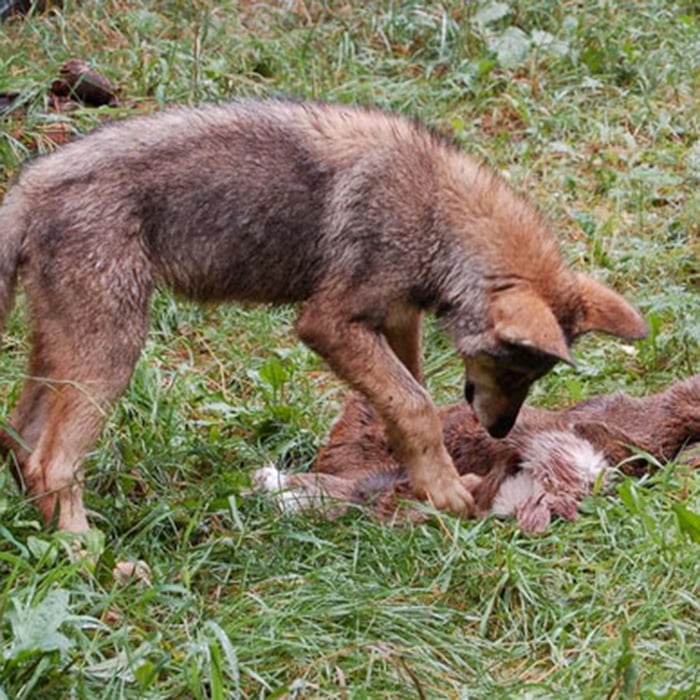
Ungulates have adaptations for defense against wolves, including a great sense of smell, good hearing, agility, speed, and sharp hooves. As these prey are so well adapted to protecting themselves, wolves are often labeled as “opportunistic carnivores” feeding upon what offers the easiest opportunity, such as vulnerable individuals, including weak, sick, old, or young animals. But they may prey upon healthy animals that are hindered by deep snow or domestic livestock that are confined or have lost their adaptations for defense. By killing the vulnerable or sick animals, wolves may help increase the health of their prey population over time. One study suggested that diseases such as Chronic Wasting Disease may be curtailed by wolf predation (Wild et al., 2011). Maintaining prey populations at a lower level offers more food for healthier individuals. Such “culling” also helps ensure that the fittest animals which are best suited for their environment reproduce most often. Over many generations, this selection helps the prey species become better adapted for survival.
Studies of wolves throughout Northern Minnesota have always identified the importance of a variety of prey species in the wolves’ diet. Specifically, the seasonal availability of beaver can be critical as a spring and summer resource for growing pups. Recent studies in Northern Minnesota (Freund et al., 2023; Gable et al., 2018) have found that wild wolves living in Minnesota may also utilize fish as a significant source of food in the spring.
Studies have also shown that deer hunting success by wolves varies with experience and skill. Yearling wolves, for example, are much less experienced and are less successful at killing fawns in comparison to a breeding adult. Further, killing an adult deer often “takes a village.” Fortunately, one deer may feed a pack of wolves for several days. Due to hunting success, wolves often live a feast or famine lifestyle; they may go several days without a meal and then gorge themselves consuming up to 20% of their body weight of meat when a kill is made.
Wolves and deer
In Minnesota, for example, a wolf may feed on beaver, snowshoe hare, adult deer/fawns, adult moose/calves, and in recent studies in Voyageurs National Park, fish and even blueberries (Gable et al., 2017; Homkes et al., 2020). Equating food consumption specific to deer is not easily defined in a multi-prey system. Data on wolf/prey consumption in places such as Isle Royale has fewer variables (wolves only – no coyotes or bears and moose only– No white-tailed deer) allowing for more precise data on predator prey relationships. In most of Minnesota wolf range, deer have additional large predators including bears (primarily on deer fawns) and transient cougars. There are also smaller predators called mesocarnivores that are lower in the food chain but may still prey upon deer, such as bobcats and fishers. An added calculation must include losses to scavengers as ravens, eagles, turkey vultures, foxes, bears, coyotes and many more species will benefit from a wolf kill.
Minnesota hunters, winter conditions and vehicle collisions also impact deer populations. For example, hunters harvested about 170,000 deer during the 2022 season. To learn more about hunter harvest in Minnesota, check out the MN DNR 2022 Harvest data.
Winter conditions are assessed using a numerical value called the Winter Severity Index (WSI). According to the Minnesota DNR, the WSI is calculated weekly from November 1 to May 31. Scores accumulate throughout the winter, with one point for each day with an air temperature of 0 degrees Fahrenheit or lower and an additional point for each day with a snow depth of 15 inches or deeper. Winters with a total WSI value of 50 or lower are considered mild; 51 to 119 moderate; and 120 or higher are severe. A severe winter with very deep snow and prolonged cold temperatures can increase deer mortality. Yet, the WSI is not predictive since it does not include other factors such as, quantity and quality of habitat and forage available, duration of winter and timing of spring green-up, among other factors.
Several thousand deer are killed during collisions with vehicles and data are maintained by the Minnesota Department of Public Safety. Road-killed deer can be salvaged with a DNR permit, although a no-charge salvage permit which can be distributed at the time of the crash may lead to an underreporting of annual deer collisions. A recent study in Wisconsin used mathematical modeling to quantify the effects of restoring wolf populations by evaluating their influence on deer-vehicle collisions (DVC’s) (Raynor et al., 2021). Their data showed a 24% reduction in DVC’s for the average county when wolves were present. Most of this reduction was due to behavioral responses of the deer to the wolves presence rather than a deer population decline.
Additive or Compensatory Predation?
The question of whether wolf predation is additive (the number of animals killed are in addition to those which would die otherwise) or compensatory (animals wolves kill would die anyway) is a complicated one, as wolf predation effects vary with the prey species, time of year, area, and system. It is quite probable that wolf predation is both additive and compensatory, and the real question is how much of it is additive.
For example, wolf predation on deer is moderated by the severity of the winters. In a severe winter, wolves may kill healthy deer which would have survived the winter had they not had been made vulnerable by the deep snow. This would be an example of wolf predation as an additive factor. Conversely, in a mild winter, when the snow levels are low, healthy deer easily escape wolves. Therefore, the deer captured are primarily sick or weak. This would be an example of compensatory mortality, as most of these deer probably would not have survived the winter. This is why it is rare to find a starving deer in Minnesota wolf range.
Reciprocally, prey populations may limit wolf numbers. When considering the examples above, the potential for prey numbers or conditions to regulate wolf numbers is observable. In a mild winter, deer will be healthier and wolves may not be able to catch enough animals to feed themselves. This may cause a decrease in the wolf population. It is also possible that several severe winters in a row would decrease deer populations and wolves may not be able to kill enough food to eat, so again wolf numbers would decrease.
Multiple predator ecosystems
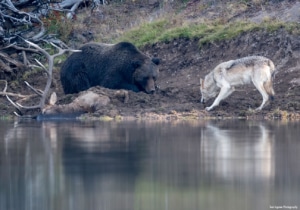
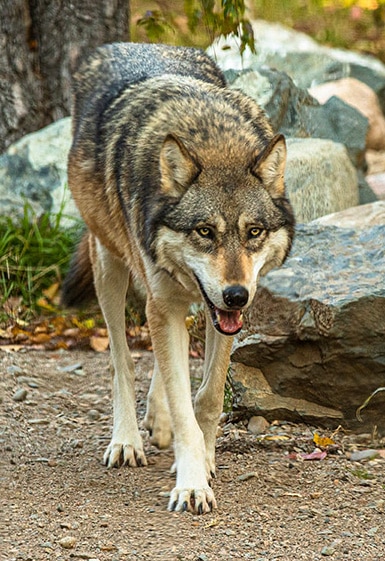
Another factor complicating our ability to determine the precise effect of wolf predation, is that it is difficult to tease out the effects wolves have on their prey populations in areas where there are many different predators. For example, in Yellowstone National Park, in addition to wolves, there are grizzly bears, coyotes, mountain lions, bobcats, lynx, wolverines, and black bears which all prey on Yellowstone ungulates.
In summary, we cannot generalize about what kind of effect wolves have on their prey populations, because their effect is dependent on so many factors. It is possible to get an indication of wolf and prey population trends in a small area or system, but generalizing from one to the other is not always valid.
 Wolves and Brown Bears: The nature of competition between two top predators
by Aimee Tallian
What happens when two top predators share the same territory, competing for the same large prey? One is an omnivore that targets ungulates intermittently; the other is a meat-eater. Bears are bigger, but wolves are more numerous. Bears will lumber into a kill site and steal hard-earned meals from wolves, but wolves are patient, determined and agile. Here, learn how their interactions affect each species— and the environment. Click here to read the article.
Article featured in Fall 2022 International Wolf magazine.
Literature Cited
Freund, D. R., Gable, T. D., Johnson-Bice, S. M., Homkes, A. T., Windels, S. K., & Bump, J. K. (2023). The ethology of wolves foraging on freshwater fishes in a boreal ecosystem. Royal Society Open Science, 10(230210). https://doi.org/10.1098/rsos.230210
Gable, T. D., Windels, S. K., & Homkes, A. T. (2018). Do wolves hunt freshwater fish in spring as a food source? Mammalian Biology, 91, 30–33. https://doi.org/10.1016/J.MAMBIO.2018.03.007
Gable, T. D., Windels, S. K., & Bruggink, J. G. (2017). Estimating biomass of berries consumed by gray wolves. Wildlife Society Bulletin, 41(1), 129–131. https://doi.org/10.1002/WSB.730
Homkes, A. T., Gable, T. D., Windels, S. K., & Bump, J. K. (2020). Berry Important? Wolf Provisions Pups with Berries in Northern Minnesota. Wildlife Society Bulletin, 44(1), 221–223. https://doi.org/10.1002/WSB.1065
Mech, L. D., & Boitani, L. (Eds.). (2003). Wolves: Behavior, Ecology, and Conservation. University of Chicago Press.
Raynor, J. L., Grainger, C. A., & Parker, D. P. (2021). Wolves make roadways safer, generating large economic returns to predator conservation. Proceedings of the National Academy of Sciences of the United States of America, 118(22).
Wild, M. A., Thompson Hobbs, N., Graham, M. S., & Miller, M. W. (2011). The role of predation in disease control: a comparison of selective and nonselective removal on prion disease dynamics in deer. Journal of Wildlife Diseases, 47(1), 78–93.