This glossary includes terms you will encounter in your reading about wolves and wild lands. Boldfaced words within the definitions are words that are defined elsewhere in the glossary. An on-line search can help you with terms not included in this list.
A, B, C, D, E, F, G, H, I, J, K, L, M, N, O, P, Q, R, S, T, U, V, W, X, Y, Z
Adaptation – a change in an animal’s behavior or body that allows it to live better in its surroundings. Some adaptations in wolves include large feet with toes that spread which enable the animals to walk on snow and ice. The large, compact feet also enable the wolf to travel long distances.
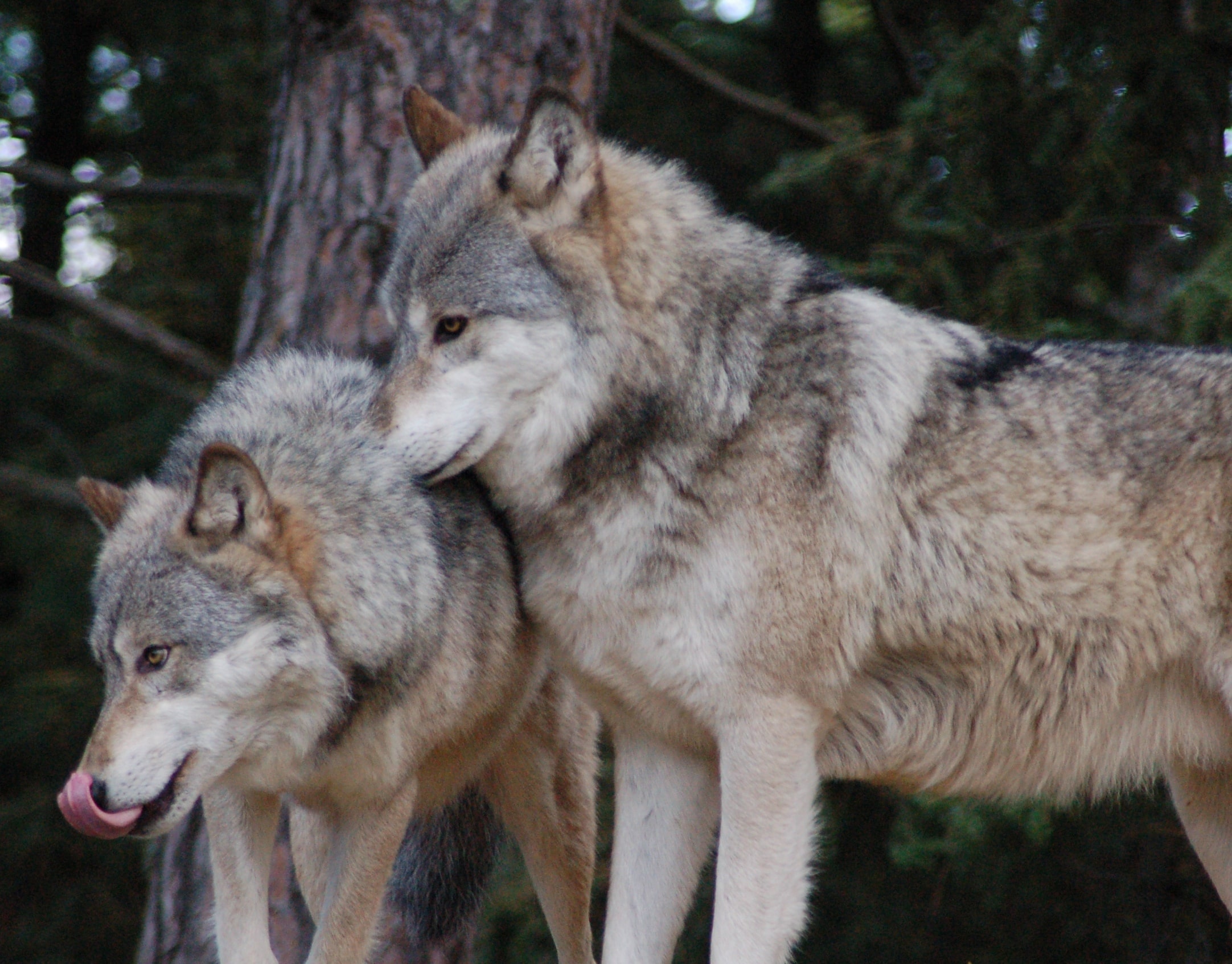
Dominant pair
Alphas – The term sometimes used to describe the dominant wolves in the social order of the wolf pack. Because a free-ranging wolf pack is a family comprising the parents and their offspring, the term “alphas” has been superseded by “breeding pair” or “breeders” or simply “parents.” (See Dominance Hierarchy) On the other hand, captive wolves that live together are often unrelated. Therefore, competition for rank in the group may take place with a resulting social hierarchy.
Anthropomorphism – The act of giving human characteristics, behaviors, feelings and/or motivations to animals or objects. Animals are frequently anthropomorphized in literature and in movies.
Behavior – What an animal does; its reactions or actions under specific conditions.
Beta – The term sometimes used to describe the second rank in the social order of a wolf pack. In what researchers now consider an oversimplified model of a wolf pack, social hierarchies were thought to operate for males and females. This implied that a pack may have both a beta male and a beta female. According to this model, a wolf at this rank would usually dominate all of the other wolves in its gender except the dominant wolf. (See Alphas and Dominance Hierarchy)
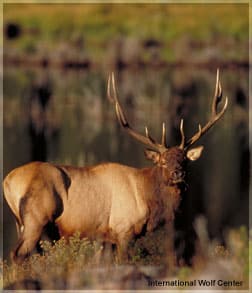
North American elk
Big Game (Large Game) – Term used to designate larger species that are hunted. Examples are bears, moose, deer, elk, caribou and bighorn sheep. In many states, selected species are legally designated as big game, small game (rabbits, squirrels, game birds) and non-game (songbirds, birds of prey).
Biological Diversity or Biodiversity – The variety, complexity and relative abundance of species (plant and animal) present and interacting in an ecosystem.
Biologist – A person who studies living organisms, life processes and/or the animal and plant life of a particular place. Biologists also study the relationship of living things to one another.
Bounty – A payment or other reward for removing or killing certain species of animals designated as harmful. Federal and state governments have used bounties as part of their predator control programs to encourage people to kill wolves.
Breeding Pair – The term used to refer to the male and the female in the pack who mate and produce offspring.
Buffer Zone – An area between territories occupied by established wolf packs. Prey species often flourish in buffer zones. Wolves that have dispersed and that are alone often find relative safety and food in buffer zones with less risk of being attacked and killed by members of established packs. However, buffer zones are not necessarily neutral areas and therefore safe havens. These zones may be contested by resident packs.
Cache – a hiding place used for storing food if there is an abundance of meat from a kill; v. to store or hide.
Canid – A member of the taxonomic family Canidae, which in North America includes wolves, coyotes, foxes and domestic dogs.
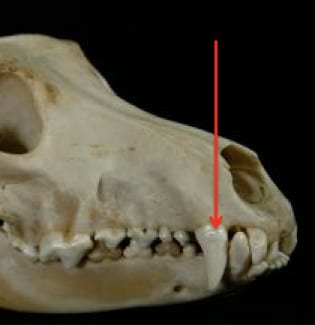
Canine tooth
Canines – The sharp, pointed teeth (fangs) that carnivores use to pierce and tear the flesh of their prey.
Canis lupus – The scientific name for the gray wolf.
Canis rufus – The scientific name for the red wolf. Two recognized species of wolves live in North America – Canis lupus and Canis rufus. Some scientists have proposed that the eastern wolf, Canis lupus lycaon is a distinct species, Canis lycaon.
Captive Breeding – Breeding animals in such places as zoos. Captive breeding is a tool to save critically endangered species such as the Mexican gray wolf (Canis lupus balleyi) and the red wolf (Canis rufus). These captive populations may be used for reintroduction in designated areas. The wolves that were reintroduced in Yellowstone National Park and central Idaho were not bred in captivity. They were captured in Canada and transported to the northern Rocky Mountains and released. The red wolves reintroduced in northeastern North Carolina were, on the other hand, bred in captivity because red wolves were officially declared functionally extinct in the wild.
Carnivore – An animal that eats meat.
Carrying Capacity – The total number of a species that a given area of a habitat can support at any given time; the ability of a given area to supply water, food and shelter to a species.
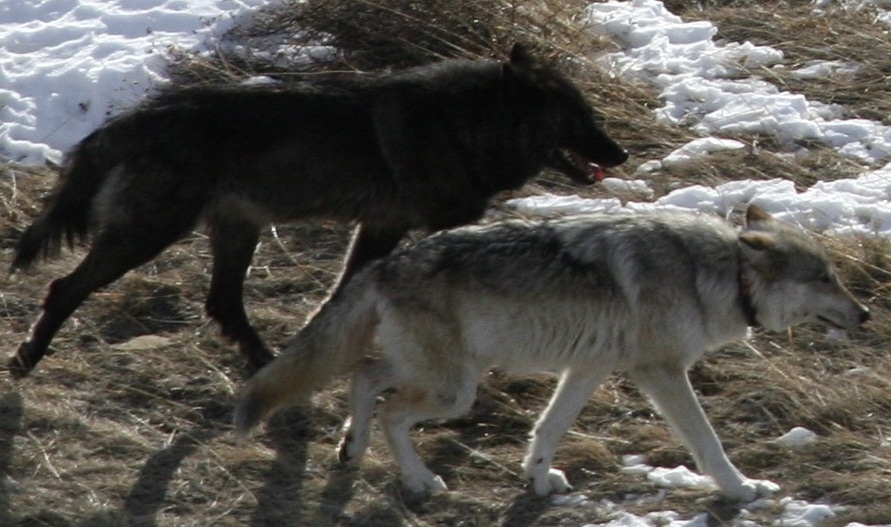
Black phase and gray phase wolves
Color Phase – The color of an animal’s pelage (fur), which is determined by genetics and may vary within a population. White, gray and black color phases may be seen within the same gray wolf population. In the Western Great Lakes region, about 98 percent of the gray wolf population exhibits the gray phase, with the occasional occurrence of white or black phases. The predominant color phase within a population often corresponds to the overall color of its environment. For example, the white color phase is predominant in arctic regions. The word “phase” does not imply that a wolf changes color.
Conservation – Protection of natural resources from loss, waste or harm; the wise and intelligent use of natural resources so they will be available for future generations.
Den– A shelter, often a small cave or hole dug out of the ground, to protect the breeding female and her young pups from weather and other animals.
Delisting – Removing a plant or animal from the list of endangered species when it is no longer in danger of extinction.
Depredation – Refers to damage done by wildlife to people’s crops and domestic animals. This term is primarily used when referring to situations involving wolves or other carnivores killing or maiming domestic animals, such as livestock.
Dispersal – The act of an organism leaving its birthplace and moving to where it will live as an adult. Dispersal in wolves usually involves a young, sexually maturing wolf leaving the pack, perhaps due to rivalry with other members of the pack, intense bonds formed with an individual wolf from outside of the pack or lack of sufficient resources within the pack’s territory to support the number of wolves present.
Disperser – A wolf that leaves the pack and strikes out on its own. Some of these “lone wolves” have no social territory, and they live on the fringes of established packs or in the areas where several territories come together. Their single status may make them vulnerable to malnutrition and to attacks by other wolves. Dispersers will sometimes hunt in unoccupied areas between pack territories called buffer zones. Some wolves are seeking a partner and may travel hundreds of miles from where they were born. Males and females may meet and form new packs if they can find unoccupied territory with sufficient prey.
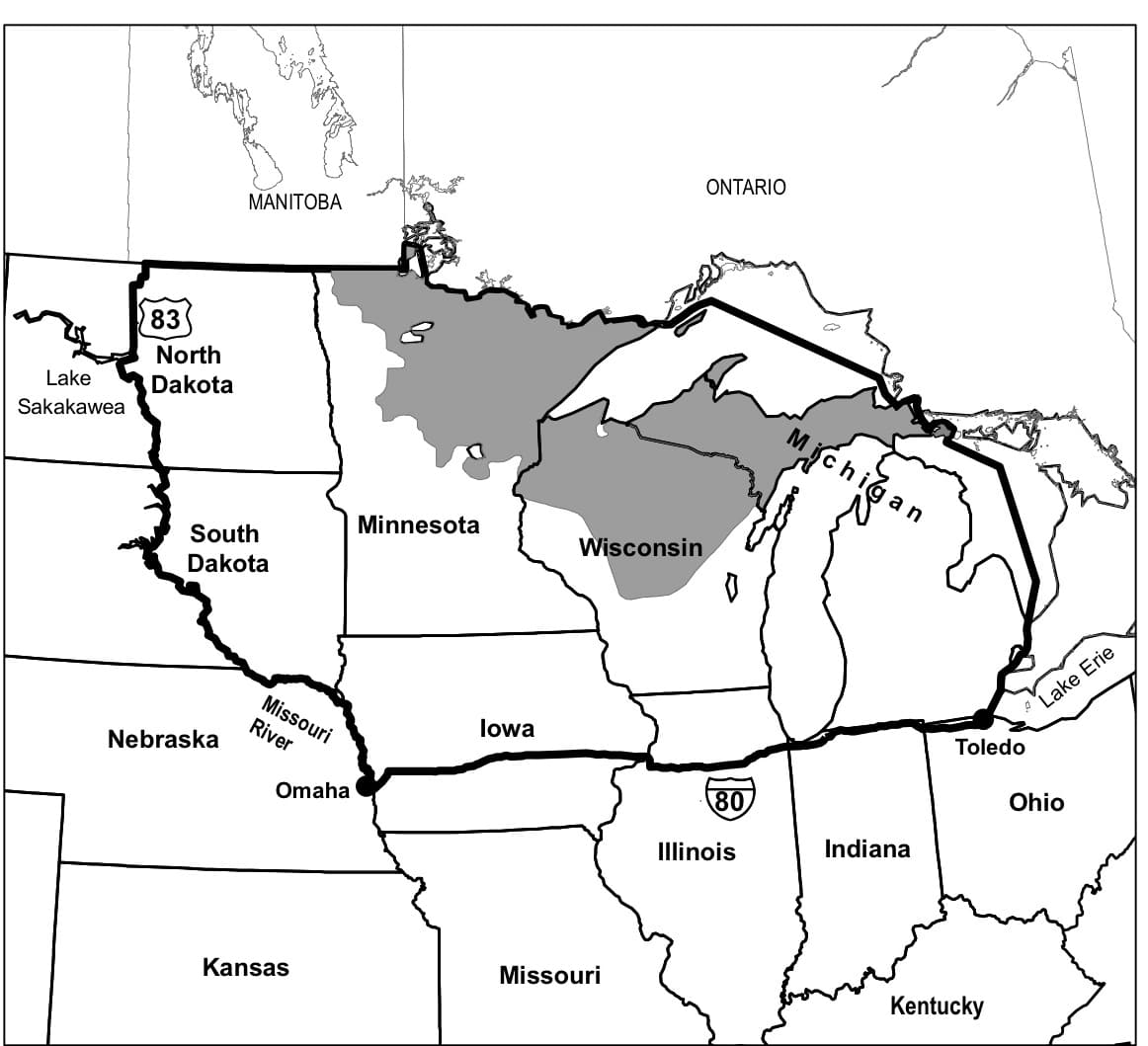
Example of a DPS
Distinct Population Segment (DPS) – A term created in the 1978 amendments to the Endangered species Act (ESA) allowing vertebrate species to be divided into distinct groups based on geography and genetic distinction. This controversial amendment to the ESA allows the United States Fish and Wildlife Service (USFWS) to adopt different management practices, including the level of protection, for different populations according to their need. The current DPSs are Northern Rocky Mountain, Western Great Lakes, Southwestern and Eastern.
Domesticated – Referring to species which have descended from wild ancestors but have been tamed, kept in captivity and bred over many generations for human purposes. They are usually dependent upon humans for their survival.
Dominance Hierarchy – A linear “chain of command” concept describing rank within a wolf pack established through competition and conflict. According to this model, the strongest male and female are the “alphas,” and the second in rank are the “betas.” The “omega” wolf is the lowest ranking wolf, often having to beg food and always losing fights. While this status hierarchy may exist in captive packs comprised of unrelated individuals, natural wolf packs usually consist of parents and their offspring of various years. In a free-ranging wolf family, each wolf seems to know its standing and communicates it to the others. The parents are in charge, with the older siblings next in order of dominance followed by the pups of the current year.
Dominant – Having power, control and privilege over others within a social hierarchy.
Ecologist – A scientist who studies the interrelationship of living things to one another and to their environment.
Ecology – The science of relationships between plants, animals and the environment.
Ecosystem – A more or less discrete system or community formed by the interaction of living organisms with each other and with the physical factors found in their environment.
Encroachment – The physical occupation of space or habitat which was previously occupied by another species, resulting in displacement of this species or destruction of the species, if no alternative space or habitat is available.
Endangered – Referring to a species (plant or animal) currently in danger of extinction.
Endangered species Act – A Congressional act (16 U. S. C. 1531 et. seq.) passed in 1973 and amended through the years that provides for the identification and protection of species (plants and animals) currently in danger of extinction or threatened by extinction within the foreseeable future.

Experimental Population Designated Area
Experimental Population Designation (Section 10(j) Rule) – a concept added to the Endangered Species Act (ESA) as a way of reintroducing a species without severe restrictions on the use of private and public land in the area. Members of an experimental population can have special rules written for them which may include killing animals causing depredations (killing or harming domestic animals and/or livestock). This was proposed in order to reduce public opposition to the reintroduction of a major predator such as the wolf. If loss of the population would diminish the species‘ prospects for survival, the population is designated as essential and is treated as an endangered species. If the experimental population is designated as non-essential and is treated as a species that is proposed for listing as threatened or endangered. Examples of species with non-essential experimental populations are the Mexican gray wolf in the Southwest, the red wolf in the Southeast, the gray wolf in the Yellowstone area and the black-footed ferret.
Exterminate – To get rid of by destroying or killing.
Extinct – No longer in existence. Once a species is extinct, all individuals within this species have forever vanished from the planet.
Extirpate – To destroy or eliminate a species (plant or animal) from an entire area within its range, but not from the entire planet.
Feast-or-Famine Diet – The behavior of eating a great deal of food in a short time and then not eating for an extended period. A single wolf has been known to eat up to 22 pounds of meat at one time. The wolf then rests while this food digests. It may be several days or several weeks before the wolf gets another significant amount of food.
Federal Register – A periodical published by the United States Government which advertizes actions or proposed actions by federal agencies. The Federal Register is available at all major libraries and federal offices. It is the federal government’s primary means of releasing information to the public.
Feral – Domesticated animals that have gone wild. Examples are wild burros, goats, pigs, cats and dogs. There is an important distinction between a feral dog and a wild dog. Sometimes livestock depredations are blamed on wolves when, in fact, the killing was done by a feral dog or a hybrid.
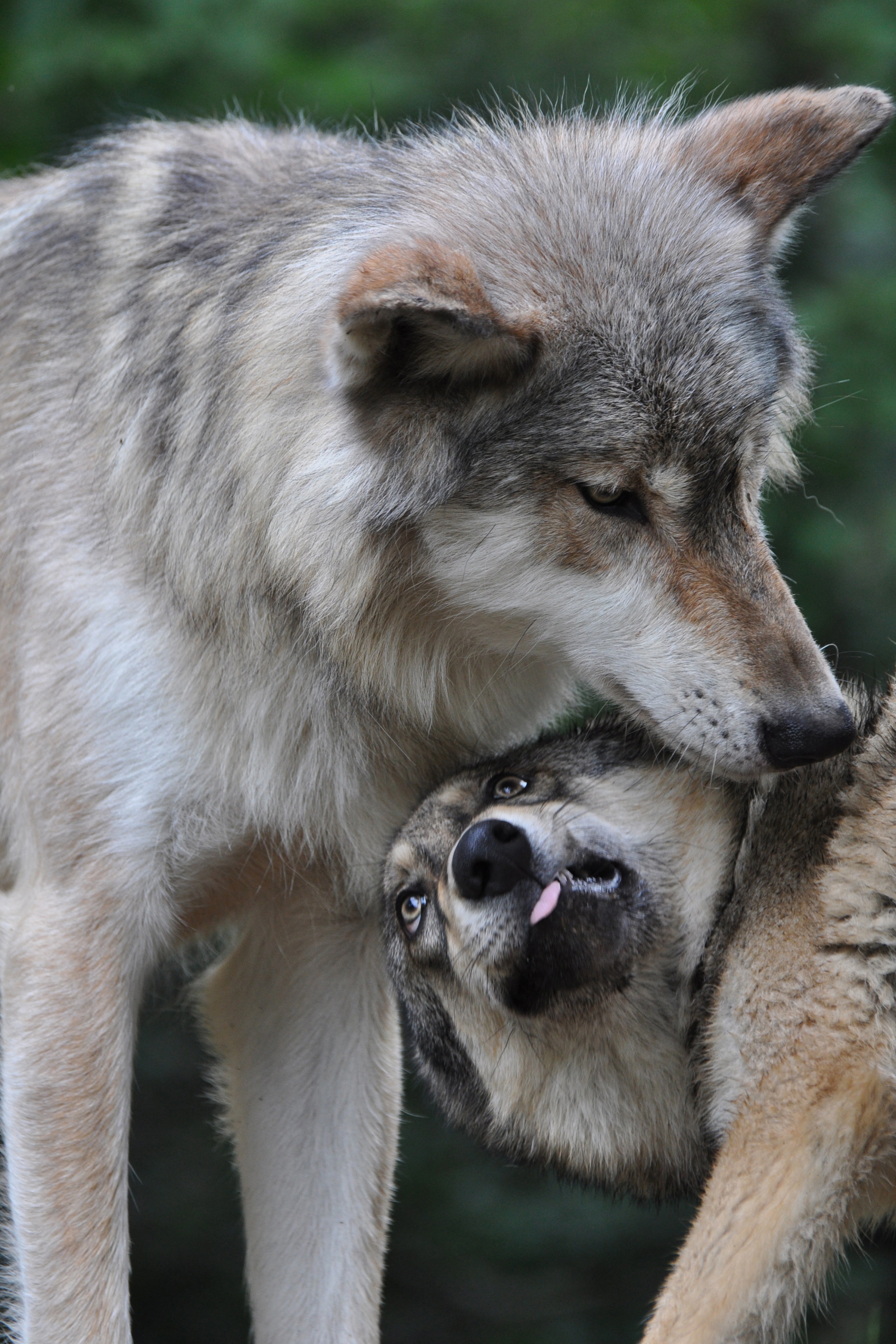
Food begging behavior
Food-Begging – A behavior which pups and sometimes sub-adults use to get food from dominant members. The pup or subordinate lowers its body posture and licks around the muzzle of the wolf with the food. It may whine. Pups may induce adults to regurgitate food by engaging in food-begging. Adults with food may simply give some or all of the food. The breeding female sometimes uses food-begging to induce the breeding male to deliver food to her when she is confined to the den with young pups.
Game Animals – Legal name for animals that may be regulated and hunted under regulations and laws.
Genus – Part of the classification system used to identify plants and animals. Wolves are of the genus Canis along with coyotes and domestic dogs.
Gestation Period – Pregnancy – The period between fertilization and birth. For a wolf this period is 62 – 63 days.
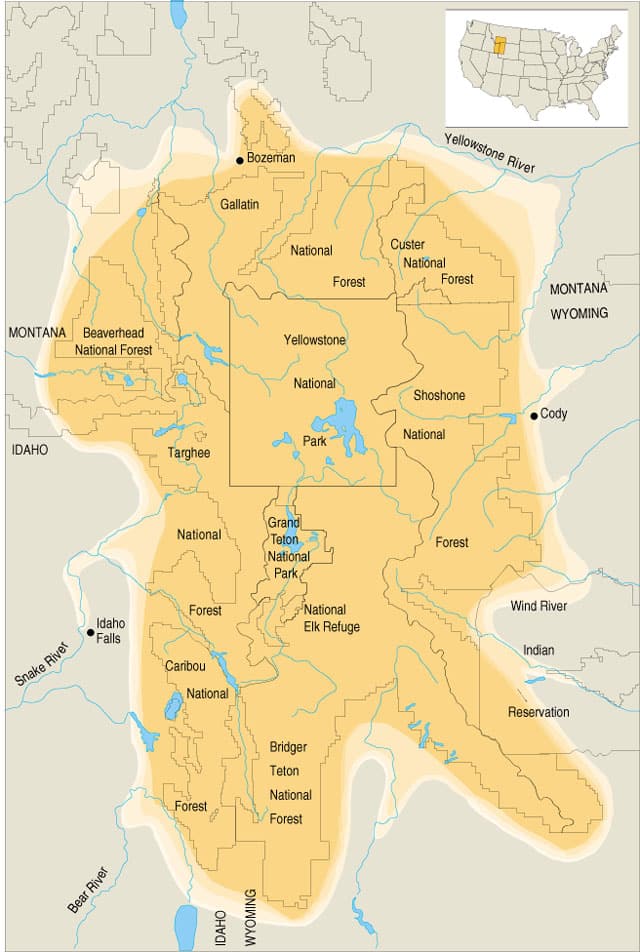
Greater Yellowstone Ecosystem
Greater Yellowstone Ecosystem – The geographical area including parts or all of: Yellowstone and Grand Teton National Parks, Beaverhead, Gallatin, Custer, Shoshone, Bridger-Teton and Caribou National Forests, and various National Wildlife Refuges; the headwaters of three major river systems: the Yellowstone, the Snake and the Green Rivers; and parts or all of the Salt River, Northern Rocky, Absaroka and Wild River Mountain Ranges. Greater Yellowstone encompasses an area roughly the size of West Virginia and is home to some of the world’s most unique wild lands and wildlife that together constitute one of the earth’s most diverse and dynamic natural regions. Greater Yellowstone Area map.
Guard Hairs – The long outer hairs of an animal’s coat that keep the downy underfur from getting dirty or wet. The underfur keeps the animal warm by preventing heat loss from the body.
Habitat – The natural environment of a species (plant or animal) that provides the food, water, shelter or cover and space required for it to survive. Forests, deserts and lakes are but a few examples of habitats.
Habitat Destruction – The act of destroying an entire habitat or any significant part within the habitat.
Hard Release – One method of wolf recovery is the reintroduction of wolves to areas from which they have been extirpated. In a hard release, wild wolves are brought from another area and released immediately without a period of time to acclimate to their new surroundings. The hard release method was used in central Idaho when wild wolves were brought from Canada and released without spending a period of time in “holding pens.” Reintroduction of wolves to Yellowstone was, on the other hand, done by the soft release method.
Harvest – The intentional gathering of plants, animals and natural resources. In wildlife management, hunting is one form of harvesting in which animals are killed.
Hybrid – The offspring resulting from reproduction between two closely related species, Dogs, wolves and coyotes can interbreed and produce fertile offspring. The subject of wolf-dog hybrids is controversial. Many people believe that if they obtain such a hybrid, they will get an animal that looks like a wolf and acts like a dog. This is often not the case, however. Hybrids sometimes have a dog’s aggressive nature combined with a wolf’s shyness and fear of humans. This combination can produce an “aggressive predator,” a potentially dangerous animal.
Indicator Species – a specific species selected for monitoring by animal scientists in order to get a general indication of the health of the ecosystem in which the animal lives.
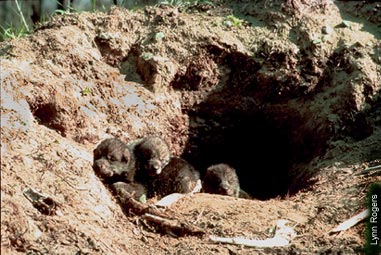
Litter of pups
Litter – All of the pups born during a single birth to an adult female wolf.
Livestock – Animals that are domesticated, such as cattle, sheep, horses and mules that are raised on a farm or ranch.
Longevity – Length of time an animal lives.
Management – The act of providing direction for the use, control, enhancement or protection of a species (plant or animal) or its habitat.
Mange – a skin condition caused by a parasitic mite. Mange is characterized by intense itching and hair loss. Excessive hair loss can result in hypothermia and death.
Mortality Rate – The relative frequency of deaths in a population.
National Forest – An area of public land designated and managed by the federal government (Forest Service) to assure an ongoing supply of natural resources. These include grazing land for livestock, minerals, timber and opportunities for recreational and scenic use.
National Park – A tract of land declared public property by the federal government to be used for cultural and recreational purposes. National parks are managed by the National Park Service.
Omega – The lowest ranking member in the social order of a wolf pack. Natural wolf packs may not have a single omega wolf. However, low-ranking members of a wolf pack such as young, sexually maturing males and females may become dispersers, especially if food is scarce.

Yellowstone wolf pack
Pack – A family of wolves that lives and works together to hunt for food and take care of the pups. It usually consists of a male and female parent (the breeding male and the breeding female or breeding pair) and their offspring from one or more generations. The size of the pack may depend on prey density and size. For example, wolves that prey on moose or bison may form larger packs because these large animals may be easier to kill when two or more wolves participate. However, a large pack requires a lot of food; the more wolves, the more quickly a kill is consumed.
Pelage – The entire coat of hair or fur, including the soft, furry undercoat as well as the coarse guard hairs, on a mammal.
Pelt – The skin and fur of an animal. Note that the pelage is the coat of hair and fur. The pelt is the skin as well as the hair and fur.
Persecution – Harassment or cruel treatment.
Pinch Period – The period in the annual cycle when the conditions for living and finding food are least favorable. For wolves, the pinch period is often in late summer when prey are in prime condition and difficult to catch, but when growing pups still need to be fed.
Poaching – Illegal taking of wildlife.
Population – All of the individuals from the same species (or closely-related species) that are closely associated and that occupy a certain area.
Predation – The act of an animal capturing and eating other animals.
Predator – An animal that captures and eats other animals.
Preservation – Protection of wildlife and habitat which emphasizes non-consumptive values and uses such as no direct use by humans. Conservation, on the other hand, emphasizes both consumptive and non-consumptive use of resources.
Prey – An animal that is captured and eaten by another animal.
Public Lands – Lands owned by the general public and managed by state or federal agencies such as the National Park Service or the Forest Service.
Rank – The relative social positions of animals in a pack. The more dominant animals are higher in rank. In a free-ranging wolf pack, the highest ranking members are usually the parents. The older siblings are higher in rank than the pups of the current year. In a captive group of wolves, rank may be determined through competition and sometimes conflict.
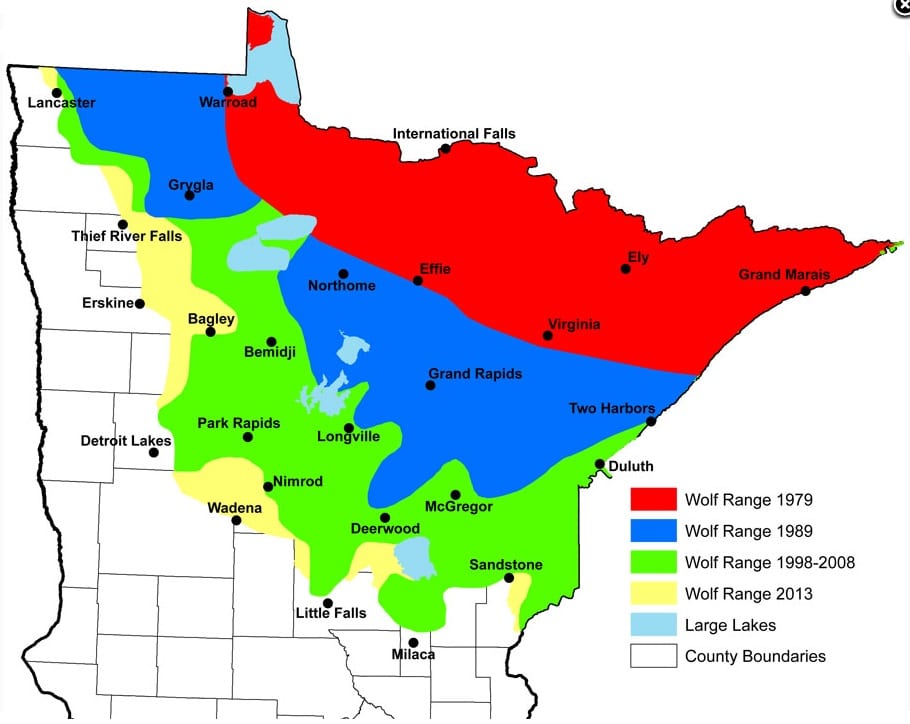
MN wolf range map
Range – The geographic area over which an entire species is distributed. This range is usually determined by the available habitat needed by a species to survive, thus range can change as the available habitat is altered or destroyed.
Recolonization – The natural restoration of a population to an area within its original range.
Recovery – The natural or assisted restoration of a population to specified levels for minimum number of consecutive years to a designated area within its original range.
Reintroduction – The act of bringing individuals of a certain species (plant or animal) back into a designated area within the species’ original range, but from which it was extirpated or nearly eliminated. The purpose of reintroduction is to establish a new population in the wild.
Rendezvous Site – An above ground area, usually open and near water, where pups are taken when they are old enough to leave the birth den. The wolves gather there to sleep, play and eat. Wolves may move from one rendezvous site to the next until the pups are old enough to accompany the adults on their hunts and travels.
Resident Wildlife – Animals that are residents of a specific area on a year-round basis as opposed to migratory animals.

Wolf scat
Scat – Fecal matter or feces.
Scavenger – An animal that eats animals it did not kill directly but that have died from other causes such as disease, starvation or predation.
Scent-marking – The act of marking an area with body odor, scent from a gland, or urine or scat. This technique is used by wolves to communicate with other wolves and animals. For example, scent marks tell other wolves the locations of a pack’s territorial boundaries.
Social Animal – an animal that lives in a group with its own kind. Wolves are highly social animals because they live in a pack or family according to strict cooperative rules. The pack members are dependent on one another for survival, and they all participate in the care and nurturing of the young.
Soft Release – A reintroduction strategy whereby the animal is brought to the release area and kept in a “holding pen” or enclosure in order to become acclimated to its surroundings. Soft release was used with the reintroduction of the wolves to Yellowstone. The central Idaho wolves were, on the other hand, reintroduced by hard release.
Species – A subgroup of genus and part of the classification system scientists use to identify plants and animals. Although there is some debate among scientists, two species of wolves are recognized in the U.S. – Canis lupus, the gray wolf, and Canis rufus, the red wolf. The proper name of a species is made up of two words: the genus name (Canis) and the specific name (lupus or rufus).
Species Survival Plan (SSP) – An organized method of breeding endangered species in captivity in order to increase their populations. Managed by the American Zoo and Aquarium Association (AZA), there is an SSP for Mexican gray wolves and one for red wolves.
State Wildlife Agency – The state agency that has legal responsibility for the management of all or some of the wildlife in that state. It is usually responsible for regulations and for law enforcement.
Stewardship – Refers to responsible caretaking of the environment. Stewardship is based on the premise that we are managers of natural resources and that we are responsible to future generations for conserving and preserving these resources.
Stress – A harmful pressure to an organism or a. A drought or flood or a severe winter would cause stress to a plant population and, therefore, to animals.
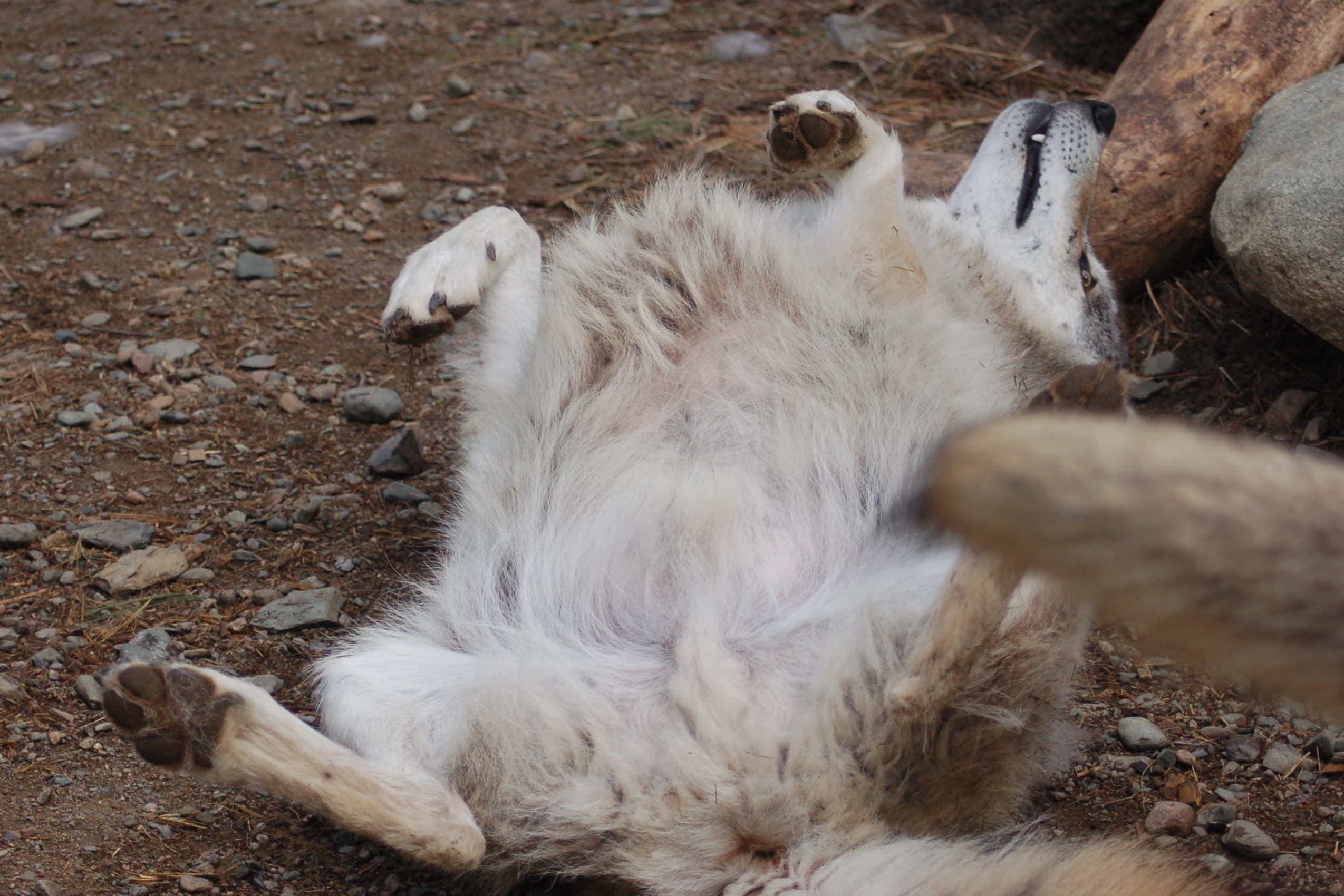
Passive submission
Submission – The act of acknowledging another animal’s dominance or higher rank. Wolves do this in several ways including lying on their back and exposing their bellies, lowering their tails (or tucking the tail between the legs), flattening their ears against their heads and assuming a lower body position. Another behavior exhibited by submissive wolves is food begging.
Subordinate – Lower ranking in power, control and privilege.
Subspecies – Part of the classification system scientists use to identify plants and animals. It is the most specific group of animals. Scientists disagree on how many subspecies of wolves there are, but in North America, for example, 5 subspecies of Canis lupus, the gray is the generally accepted number. Two examples areCanis lupus arctos, the arctic wolf, and Canis lupus baleyi, the Mexican wolf.
Tame – Brought from wildness into a manageable or easily controlled states. Tame animals may be handled by humans and used in some cases to perform work, Domesticated animals, on the other hand, are animals that have, over a series of generation, become accustomed to living with humans and which have, to varying degrees, become dependent upon humans to provide for their needs. Domestic animals that live in a wild state are call feral animals.
Taxonomy – The classification or organisms in categories based on common characteristics.
Telemetry – The use of electronic equipment to locate a distant source. Researchers use telemetry equipment, such as receivers and antennae, to locate signals emitted from radio collars worn by wolves in their study groups.
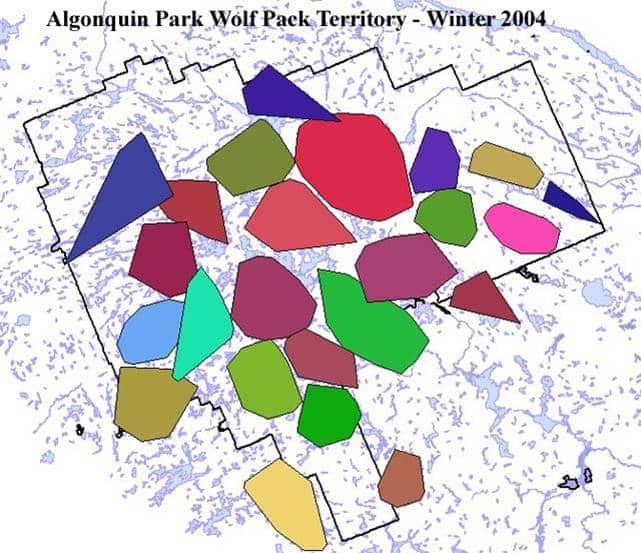
Sample map of wolf pack territory boundaries
Territory – An area occupied by a pack of wolves that can provide sufficient prey to support the pack. It is defended against wolves from outside of the pack and from other animals that might compete for the same resources. Wolves protect their territory by scent-marking, vocal communication and by harassing or fighting wolves that trespass.
Threatened – Referring to a species (plant or animal) that could become endangered in the foreseeable future.
Top Predator – A predator, usually large in size, that is rarely killed by other predators and may kill smaller predators. Wolves are top predators and have few natural enemies. They may kill smaller predators such as coyotes. Sometimes wolves and bears will tangle, but this is infrequent as such encounters can be dangerous or deadly to both.
Track – A print left by an animal. Wolf tracks are large in comparison to most domestic dogs and other canids such as coyotes. The front feet are larger than the back feet. Claws are usually visible. This is one way to distinguish a wolf track from a mountain lion track. Mountain lions (cougars) walk with their claws retracted the way a domestic cat does.

Tracking device
Tracking Devices – The development of the transistor radio in the 1950’s lead to the ability to fit animals and birds with VHF collars. Miniaturization was the key to making this possible. Several types are collars are deployed on wolves: (1) VHF Tracking Collar (2) Satellite Collar (3) Global Positioning Systems (GPS) Collar (4) GPS/Argos Collar Satellite collars are particularly useful for long-range movement. Implants are sometimes used for animals with cone-shaped heads but are not as efficient as collar transmitters because flesh can attenuate the signal.
Translocate – To move animals from one area to another. For example, wildlife managers translocated wolves from Canada to Yellowstone National Park and to central Idaho as part of the reintroduction effort in the northern Rocky Mountains.
Ungulate – A hoofed mammal, such as deer, elk, mountain goat, bighorn sheep, moose, antelope, caribou and bison.
Viable Population – A self-supporting population with sufficient numbers and genetic variety among healthy individuals and breeding pairs that are well enough distributed to ensure that the species will not become threatened, endangered or extinct in the foreseeable future.
Western Great Lakes Area – The area in the United States south and west of the Great Lakes – especially Minnesota, Wisconsin and Michigan.
Wild – Not tame or domestic. Wild animals obtain their own food and provide for their own needs in an area that serves as a suitable habitat.
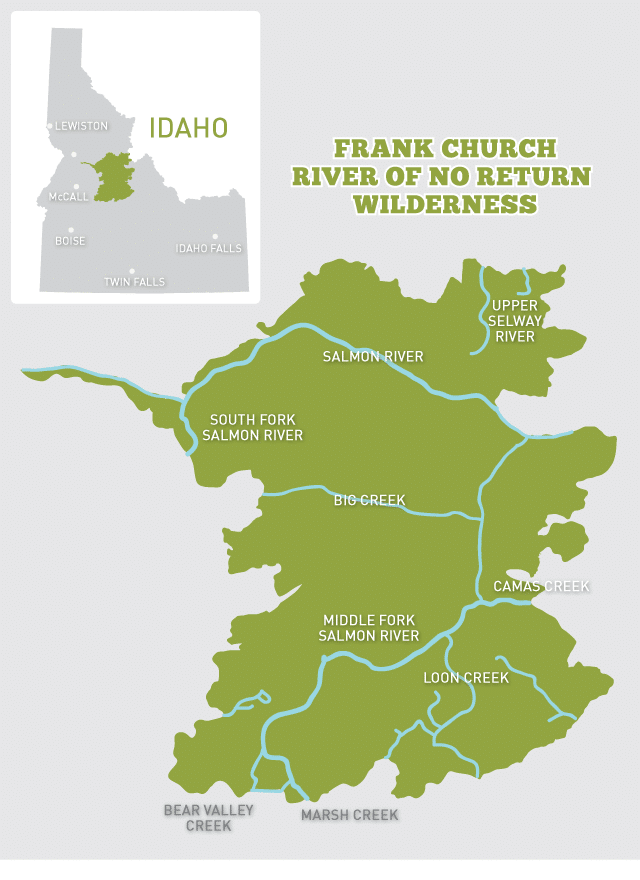
Example map of a wilderness area
Wilderness Area – An uninhabited area left in its natural condition. Wilderness areas designated by the federal government are for non-consumptive use of resources, although hunting is permitted during designated season. In some cases, wildfires are not fought in federal wilderness areas, and no machinery is permitted, not even chain saws. Visitors are encouraged to “leave only footprints, take only memories.”
Wildlife – Animals that are not tamed or domesticated. Wildlife can range in size from microscopic organisms to animals as large as whales.
Wildlife Management – A term referring to the technical and scientific skills applied to protect, conserve, preserve, extend and limit the value of wildlife and wildlife habitat.