
Who’s Afraid of the Big Bad Wolf
By L. David Mech
Editor’s note: In this article, originally published in the Spring 1998 issue of International Wolf magazine, wolf expert L. David Mech addressed the issue of whether wolves pose a physical danger to humans. Reports of wolves killing children in India and of a wolf attack on a sleeping 11-year-old camper in Canada raised concerns among the general public about the danger of wolves, and Mech, who had written on the subject in a 1992 International Wolf article, felt it was time to revisit the issue.
“There’s never been a documented case of a healthy wild wolf killing or seriously injuring a person in North America.”
Many of us have heard this statement, or even uttered it ourselves, especially those of us who study wolves or try to teach the public about them. But just how true is the statement, and why the qualifiers? The statement has been around for many years. Has there never been an exception? Furthermore, if wolves do not attack people, why don’t they?
As one whose job has required me to deal up close with wolves regularly, I have tried to keep track of these issues. I have spent the last 12 summers virtually living with a pack of wild wolves in the high Arctic just 600 miles from the North Pole. Every night during those summers only the thin nylon of my tent separated me from the wolves while I slept. Often, adult wolves howled or barked, or pups whimpered, a few feet from my head, interrupting my sleep. Even when I was outside my tent eating, or sometimes when otherwise indisposed, my summer canid companions would nose around and make me chase them off. This doesn’t count the number of times I have caught them rolling around on my freshly-cleaned undershorts that I had spread on the tundra to dry.
All in all, I have worked and lived around 16 of these Arctic wolves, and none has ever made me feel afraid of it. One got into the habit of lying outside my tent like a dog while I slept. Another let me sit among her pups and take notes while she nonchalantly howled only a few feet away. Others once stuck their heads inside my tent and pulled my sleeping bag out; fortunately I was watching from a distance and was able to get them to drop it by letting out a sharp hoot.
Nevertheless, these are the same wolves I have watched tackle an adult musk ox and tear it apart. Their jaws were strong enough to crack the ends off the musk ox’s three-inch-wide leg bones. Relatives of these wolves to the south have been able to crack open the skulls of adult moose. It is clear that wolves could easily kill a human if they so desired. Yet, at least until recently, no one has ever turned up dead, missing, eaten or even seriously injured by a nonrabid wolf during all the many millions of visitor days in our national forests, parks and other wilderness areas where wolves reside.
In fact, even the “close calls” between wolves and humans in North America have been rare enough to warrant documentation in scientific journals. Such reports include wolves treeing several botanists who happened to be in the general vicinity of a wolf den in Canada’s Northwest Territories; a wolf biting a man in the Arctic who tried to pull the animal away from his sled dogs with whom it was fighting; and a wolf grazing its tooth across the cheek of a paleo-botanist as the animal — which appeared to be merely curious — jumped at the woman on Ellesmere Island near the North Pole.
Two interesting wolf-human encounters in northeastern Minnesota add further to the mix of ways in which wolves have interacted with humans, without the humans coming out seriously injured. The first incident involved a logger who saw two wolves attacking a deer nearby. The logger picked up his dog, which had become extremely frightened by the deer attack. One of the wolves charged toward the man and dog, catching a lower fang on the logger’s black-and-red checkered wool shirt and slicing a six-inch gash in the material. As the wolf tried to yank free from the logger’s clothes, its jaws opened wide and the logger looked right down the animal’s throat.
“It wasn’t me the wolf was attacking,” the logger told me. “He was trying to get the dog who just happened to be in my arms.”
The second Minnesota incident left a 19-year-old hunter with a long scratch from a wolf’s claws. The man had been hunting snowshoe hares deep in a thick swamp north of Duluth during a snowstorm. He was wearing his deer-hunting jacket, which was well anointed with buck scent. Suddenly a wolf hit him from behind and knocked him over onto his back. As the wolf stood over him, the startled hunter managed to fire his .22-caliber rifle. The wolf appeared to come to its senses and fled, leaving the hunter with a long scratch.
Mistaken identity? Perhaps, but if the wolf had intended to kill the hunter, it could easily have done so.
Why don’t wolves kill or injure people in North America’s forests, parks and wildernesses? This is not an easy question to answer. It is true that generally wolves are very afraid of humans. This fear is probably because wolves have been so thoroughly persecuted by humans for so long. Thus it is a rare and notable event when someone spots a wolf in the wild, even when deliberately trying.
It is because of the wolf’s elusiveness that I have had to travel to the high Arctic each summer — an area about 200 miles north of the closest Inuit village – to observe wolves at close range. Even the wolves on Isle Royale National Park in Lake Superior, which haven’t been harassed by humans since their arrival on the island in 1949, retain their extreme shyness of humans.
There are a few places, however, where wolves have either lost their shyness of people or perhaps never developed it. An example of the latter is in the high Arctic, where I live with “my pack” each summer. Examples of the former can be found in several national parks where some wolves, like some coyotes and bears, have become accustomed to people.
Why don’t these wolves, who have lost their fear of humans, attack people? The answer may lie in the fact that humans stand upright on two legs. No wolf prey does so. Furthermore, bears sometimes stand upright on their hind legs, and generally wolves try to avoid bears. Another possibility is that wolves long ago learned to avoid humans. Those wolves that didn’t learn this lesson were eliminated.
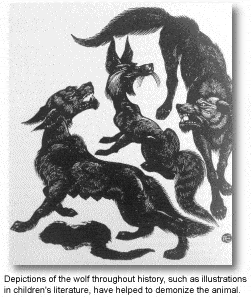
A final part of the answer, however, is rather disconcerting. I am referring here to incidents, mostly in Asia and Europe, in which wolves apparently have killed or seriously injured people. For centuries such accounts have emanated from areas like Russia, China, the Mideast, and even Spain and other European countries. Many such accounts are no doubt attributable to rabid wolves which, like rabid dogs, squirrels and skunks, will attack people. Many other accounts are clearly fabrications or extreme exaggerations, such as the 1911 newspaper report from Tashkent in the former Soviet Republic of Georgia which claimed that wolves killed an entire wedding party of 130 people.
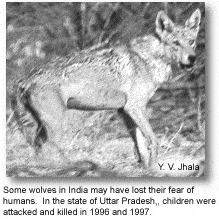
Such obvious fiction tends to cloud any serious accounts that might be valid. Nevertheless, recent reports of wolves killing people in India have been checked by qualified authorities and appear to be valid. From March to October 1996, a wolf or wolves allegedly killed or seriously injured 64 children in the Indian state of Uttar Pradesh. Dr. Yadvendradev Jhala, a U.S.-trained wolf biologist who studies wolves in his native India, investigated these reports and attempted to determine if any animal other than wolves could have been involved. By examining victims, questioning survivors and witnesses, and checking tracks, hairs and scats, Jhala concluded that a wolf or wolves were involved in the killings.
In March and April 1997, another nine or 10 humans apparently fell prey to wolves in the same area. Almost all of the victims were children under age 10 who had been playing or relieving themselves around the outskirts of small villages surrounded by heavy vegetative cover. Very few wild prey inhabit the area, and most domestic livestock are well-tended.
The young children had been left unsupervised, perhaps even neglected, by their parents at the time of their deaths. Because the government of India compensates parents of children killed by wild animals at a rate higher than average annual salaries, Indian biologists believe that there may actually be an incentive for parents not to watch their children as closely as they might otherwise. In areas where the killings occurred, wolves commonly frequent villages and sometimes even enter huts. They have obviously lost their fear of humans, or perhaps they are so desperate from lack of prey that they must resort to scavenging closely around human abodes. This combination of lack of fear, proximity to humans, and the presence of many small children in heavy cover may promote in some bolder wolves the tendency to experiment with this new type of prey. It may have taken wolves many attempts before they actually succeeded in grabbing a small child, but once one or two succeeded, the reward would have been enough to start fixing the trait in the local wolf population.
A similar combination of circumstances might explain last year’s report of a wolf grabbing 11-year-old Zachary Delventhal from his sleeping bag in Algonquin Provincial Park, Ontario, Canada.
 On August 17, 1996, a wolf grabbed Zachary by the face and tried to drag him off, causing a wound that required 80 stitches. The wolf may have been trying, however, to grab not the boy, but his sleeping bag. As mentioned earlier, the wolves I live with in the high Arctic once tried to grab my empty sleeping bag from a tent. Another time, they tried to run off with a sleeping bag that I was airing on the tundra. Wolves, like dogs, seem attracted to soft, fluffy or fur-like items, which they like to play with or rip apart. Regardless of the wolf’s intent in the Algonquin Park incident, the important factor was that the animal was accustomed to humans. It had been running off with backpacks, tennis shoes and other human items in the area for several days previous to the attack on Zachary. It had even been eating human food.
In other words, like bears that feed at dumps, garbage cans or human campsites, this wolf had not only lost its fear of humans but had been rewarded for doing so. While this combination of circumstances certainly does not always lead to incidents in which humans are injured, it appears to be a predisposing condition. Put simply, it is not a sufficient reason for wolf injuries to humans, but it does seem to be a necessary one.
As wolf populations begin to recover in both the Lake Superior and western regions of the United States, it is important that people understand this situation. Wolves are large carnivores. Like bears, cougars and domestic dogs, they should be regarded as potentially dangerous. This does not mean that wolves should be viewed with an unhealthy fear or that we must return to the days when wolves were regarded as demons. It only means that we should view wolves with the same healthy respect due any potentially dangerous animal.
L. David Mech is an internationally known wildlife research biologist who has studied wolves for almost 40 years. He is the founder of the International Wolf Center and current vice chair of the Center’s board of directors. He has published widely in scholarly and popular journals. His books include The Wolf, The Way of the Wolf and The Arctic Wolf, which has recently been reissued by Voyageur Press with an expanded text.