Select a Location
Minnesota at a glance

Minnesota wolf
Gray wolves once existed throughout Minnesota; however, extirpation (elimination) began shortly after European settlers arrived. Wolves were killed in Minnesota mostly by poisoning. A state-directed wolf livestock-depredation control program persisted until gray wolves were protected in 1974 by the Endangered Species Act of 1973. At that time, the wolf population numbered approximately 750 animals. Minnesota is the only state in the contiguous United States that has always held a viable gray wolf population.
According to federal recovery criteria, wolves in Minnesota have been biologically recovered for over a decade. They were delisted from the endangered species list in January 2012 but were re-listed on December 19, 2014. In January 2021, wolves were removed from Endangered Species List protections, and management returned to individual states. In February of 2022, once again, they became a federally protected threatened species. They are currently listed as “Threatened” in Minnesota.
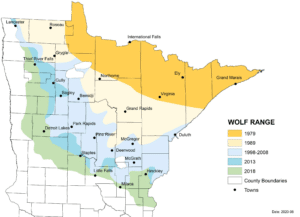
Map courtesy of the Minnesota Department of Natural Resources.
Main prey for wolves are deer, moose and beaver. The latest estimate of occupied range is 73,972 km2, with most wolves occupying the northeastern portion of the state. The latest population update (2023) estimated a total of 631 wolf packs with an average territory size of 117.2 km2. The 2022-23 midwinter wolf population was estimated to be 2,919 wolves (+/- 800), or 3.95 wolves per 100 km2 of occupied range.
The Minnesota Department of Natural Resources updated its wolf management plan and made it public in 2023. The plan incorporates the diverse views of Minnesotans and guides the state’s approach to wolf conservation. Read the 2023-2032 Minnesota Wolf Management Plan here.
Species Information
Species 1
Common Name: gray wolf
Latin Name: Canis lupus
Potential species designation under debate by the scientific community
Common Name: eastern wolf, timber wolf and/or Great Plains
Latin Name: Canis lycaon and Canis lupus nubilus
Location: C. lupus and the potential C. lycaon are indistinguishable from each other physically, behaviorally and ecologically. The only way to tell the difference between them is a genetic test and comparison.
Current Wolf Population, Trend, Status
Number of wolves: 2,919 (+/- 800) (2023 Wolf Population Update)
Population trend: Stable
Legal status: Effective Feb. 10, 2022, Minnesota’s gray wolf once again became a federally protected threatened species. Under current federal guidelines, wolves may only be taken in defense of human life.
Minnesota did have legal hunting seasons for wolves in 2012, 2013 and 2014. In 2012 hunters killed 413 wolves. In 2013 they killed 238 wolves. In 2014 they killed 272 wolves.
Human Relationships
Attitudes and Issues
- Minnesota DNR asks state’s residents for their opinions on wolves
- Full Report: The Ecocenter as a Tourist Attraction: Ely and the International Wolf Center
- Survey Shows Minnesotan’s Attitude Towards Wolves (1999)
History
Recovery and Management
Information related to legal status, hunting and trapping regulations and management plans and practices in Minnesota.
- 2012 Wolf Hunting and Trapping Season Report (pdf)
- 2013 Wolf Hunting and Trapping Season Report (pdf)
- Gray wolves in the western Great Lakes states (USFWS)
Depredation
- Wolf depredation explained
- Visit the USDA APHIS Wildlife Services site for information on how the federal government manages depredating wildlife, resolves conflict between wildlife and humans and for contact information by state.
- Harper, E. K., Paul, W. J., and Mech, L. D. 2005. Causes of wolf depredation increase in Minnesota from 1979-1998. Wildlife Society Bulletin 33:888-896.
- Mech, L. David, Fritts, Steven H., and Paul, William J. 1988. Relationship Between Winter Severity and Wolf Depredations on Domestic Animals in Minnesota. Wildlife Society Bulletin. 16:269-272.
Ecology
Biology
- 2022 Minnesota Wolf Population Update
- 2018 Minnesota Wolf Population Update
- 2017 Minnesota Wolf Population Update
- 2016 Minnesota Wolf Population Update
- Wolf population update in the western Great Lakes states (Minnesota, Michigan and Wisconsin)
Denning
- Richard P. Thiel, Samuel Merrill, and L. David Mech. 1998. Tolerance by Denning Wolves, Canis lupus,to Human Disturbance. Can. Field-Nat. 112(2):340-342. (en Espanol – Tolerancia de los lobos, Canis lupus, en temporada de preparacion de la madriguera a las alteraciones provocadas por el hombre. Translation by Marcos Randulfe.)
Prey and Predation 
- White-tailed deer studies in northeastern Minnesota
- Effects of wolf population expansion on deer hunting in northern Minnesota
- Wolves, deer, and deer hunting in northeastern Minnesota: the data
- The Ecological Relationship of Gray Wolves and White-tailed Deer in Minnesota
- Freund, D. R., T.D. Gable, S.M. Johnson-Bice, A.T. Homkes, S.K. Windels and J.K. Bump. 2023. The ethology of wolves foraging on freshwater fish in a boreal ecosystem. Royal Society Open Science.
- Gable, T. D., S. K. Windels, J. G. Bruggink, and S. M. Barber-Meyer. 2018. Weekly Summer Diet of Gray Wolves (Canis lupus) in Northeastern Minnesota. The American Midland Naturalist 179:15–27
- Gable, T. D., S. K. Windels, J. G. Bruggink, and A. T. Homkes. 2016. Where and how wolves (Canis lupus) kill beavers (Castor canadensis). PLoS ONE 11:e0165537.
- Nelson, M. E. and Mech, L. D. 2006. A 3-Decade Dearth of Deer in a Wolf (Canis lupus)-Dominated Ecosystem. American Midland Naturalist 155:373-382.
- Kunkel, Kyran E. and Mech, L. David. 1994. Wolf and bear predation on white-tailed deer fawns in northeastern Minnesota. Canadian Journal of Zoology. 72:1557-1565.
- DelGiudice, Glenn D., Mech, L. David, Kunkel, Kyran E., Gese, Eric M., and Seal, Ulysses S. 1992. Seasonal Patterns of Weight, Hematology and Serum Characteristics of Free-Ranging Female White-Tailed Deer in Minnesota. Canadian Journal of Zoology. 70:974-983.
- Nelson, Michael E. and Mech, L. David. 1987. Demes Within a Northeastern Minnesota Deer Population. Mammalian Dispersal Patterns. 2:27-40.
Recent media coverage
Minnesota’s estimated wolf population